Palestine

Applies to CPTnet releases from Palestine projects

AL-KHALIL (HEBRON) REFLECTION: The power of hope—what Palestinians are saying about recent events at the U.N.


“No!”  This is the answer one gets when you ask Palestinian shopkeepers in Hebron whether they expect anything good to come out of the recent events at the United Nations.  They cite the twenty years of broken promises—especially those of Barack Obama.  They point out the continuing political power of the Israeli settlers, the daily confiscation of more Palestinian lands and the Israeli control of 65% of the West Bank.
They have expressed many worries to CPT’s Al-Khalil team:

SOUTH HEBRON HILLS: Communities march to celebrate solidarity and nonviolence's power

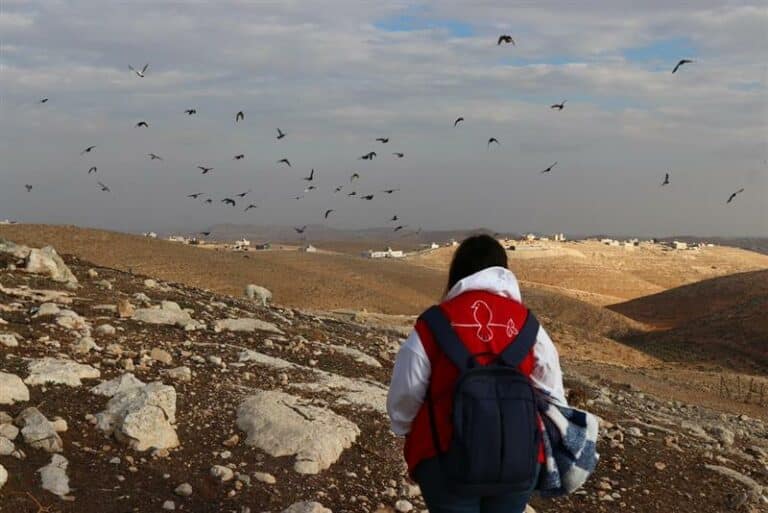
On 25 September, more than one hundred people from different communities in the South Hebron Hills participated in a peace march to celebrate the power of nonviolence and the resilient spirit of the people of the South Hebron Hills.  The event was timed to coincide with the annual Perugia-Assisi Peace March in Italy, in which 50,000 Italians and internationals participated.

PALESTINE/ISRAEL REFLECTION: You come from Germany?

 Friday, 9 September, our group of mostly German Mennonites, in the first German-speaking CPT delegation, participated in a Women in Black vigil. The Women in Black are Israelis, including Holocaust survivors, who silently protest the Israeli occupation of the land of Palestine by gathering at the same spot in West Jerusalem at the same time every week since the first Intifada.  They hold up signs in the shape of a black hand bearing the slogan, “End the Occupation” in Hebrew, Arabic, and English.

At the vigil we encountered animosity by Israeli passers-by and many of us felt uncomfortable taking part in the protest because German history.  However, although we could respond to insulting gestures and shouting and even aggressive Israeli youth by smiling and silently praying for them, we were not prepared for one particular Jewish reaction, even though we all knew exactly what that reaction would be.  The challenge of how Germans, responsible for the Holocaust and the extermination of six million Jews, could dare criticize Israel, the perceived safe haven for the Jewish people.

SOUTH HEBRON HILLS: Israeli military demolishes homes and bathroom in Umm al Kheer

The Israeli army demolished three dwellings and a bathroom in the Palestinian village of Umm al Kheer early in the morning of 8 September 2011.  According to UN field workers at the sight, the demolitions left eight adults and sixteen children homeless.

The Israeli army and the District Coordinating Office arrived at the village of Umm al Kheer around 7:00 a.m. and declared it a closed military zone, preventing Palestinians and internationals from entering the area.  The army then used a backhoe and a bulldozer to demolish the three homes and the bathroom.  According to villagers, one of the destroyed homes was a tent donated by Oxfam.  The other two were metal shacks purchased and built by the residents.  The villagers said that this was the second time that the military demolished the homes of the families living in the metal shacks.

All of the destroyed structures had existing demolition orders, but according to people from the village, the military arrived with a demolition order that was not for the three homes and the toilet, but rather for a taboun oven in the village.  The military originally wanted to destroy the taboun oven three days earlier, but a lawyer representing the village succeeded in getting a two-day stay on the demolition order.  The military did not demolish the taboun oven.

SOUTH HEBRON HILLS: Israeli army threatens village of Umm Al Kheer with demolitions

During the night of 4 September, the Israeli army delivered a demolition order for a small taboun oven to the inhabitants of the Bedouin village of Umm Al Kheer.  A lawyer representing the village obtained a two-day stop-demolition order from the Israeli High Court, temporarily delaying the demolition. In addition to the taboun oven, where the villagers bake their bread, the Israeli military has slated eleven other structures in the village, and residents of the village fear that the military may destroy those structures, and possibly others during the demolition of the oven.  “The army has come to our village twice before to demolish houses,” said a resident of Umm al Kheer who wished to be identified only as Suleiman.  “Whenever they come, they destroy five or six buildings.  They won’t come and destroy just an oven, and then leave.”

AL-KHALIL (HEBRON): Six children detained by Israeli soldiers during first day of Eid al-Fitr

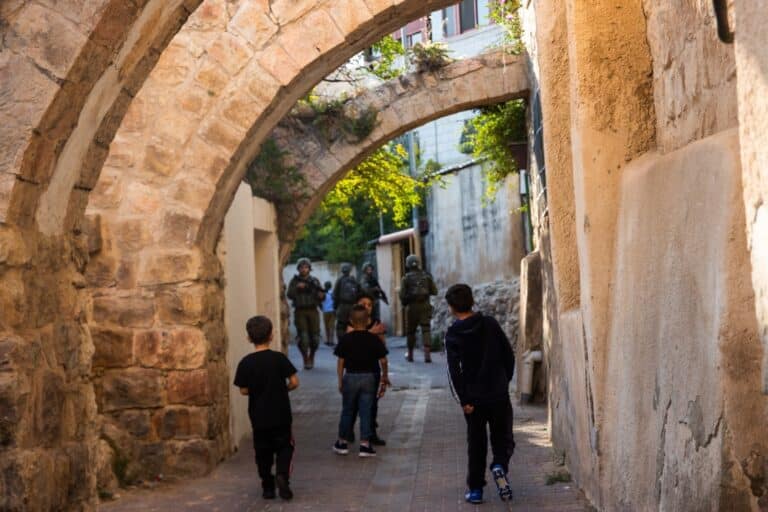
At 4:00 p.m. on 30 August 2011, Israeli soldiers detained six boys, ages five to nine, in Hebron’s Old City under the suspicion of intending to harm the soldiers with their toy guns.  The soldiers brought the children to the military compound at Bab il Baladiyye by the entrance of the old city.  

Members of Christian Peacemaker Teams observed as the soldiers detained the children for forty minutes before releasing them.  At one point the soldiers brought them into the compound to have their toy guns examined by military police officers.  This investigation took place just a couple of hours after the soldiers entered the souq (Old City market area) and held several groups of young boys based on the same suspicion.

PALESTINE: Christians Peacemaker Teams Palestine project seeks peacemakers

Christian Peacemaker Teams is seeking staff for its two project sites in Palestine, one in the southern West Bank city of Hebron (Al-Khalil) and the other twenty-five kilometers (fifteen miles) further south in the village of At-Tuwani.  For the past few months, these teams have experienced staff shortages.

Tarek Abuata, CPT Palestine project support coordinator urges prospective CPTers, “People living in Middle Eastern countries are demanding peace and justice.  New members of CPT’s Palestine team can become part of that movement by joining a project that has for seventeen years supported Palestinian-led nonviolent resistance to the Israeli occupation, and helped to create a space for peace and justice to grow.”

PALESTINE REFLECTION: The clarity of thirteen-year-olds

by Mel Southworth

A couple months ago, I gave a presentation to a grade eight English class, on the work of CPT and the Israel/Palestine conflict.  I tried to describe the situation there in a way they could relate to using the following scenario:

One year ago, a boy brought a knife to school and immediately after the incident, the principal released a statement to the media that he would increase security measures at the school.  Days later, the school administration decreed that all boys must go through a newly installed metal detector before they could enter the school building. Today, the screening process can take up to three hours; school starts at eight o’clock.  Girls do not have to go through the detector; they can enter through the back.  The administration also mandated that boys and girls must attend separate classes and if a girl is suspicious of a boy, she is allowed to request that a teacher search him for weapons.

AL-KHALIL (HEBRON): Two goats killed after Israeli soldiers attack Palestinian shepherd in Bani Na’im

At 6:30 p.m. on 14 August 2011, Israeli soldiers attacked a Palestinian shepherd and his two sons in Bani Na’im, east of Hebron, chasing the shepherd off his land and causing the deaths of two goats.Trampled Goat 3

AL-KHALIL (HEBRON): Vacations from the Occupation

When an unexpected surprise—like a small, fragile flower pushing itself through a cement block—occurs,  I feel a certain bliss, a moment of awe, an instant vacation.  For a moment, all is well.  Some such moments I have felt working in Hebron for the last three years include the following: