Colombia

COLOMBIA: Four things you should know about Colombia's armed conflict

Contrary to what major world news sources say, the war in Colombia is about more than drugs.  So much of what the global north consumes comes from Colombia—flowers, bananas, coffee, chocolate, gold, oil, coal, palm oil—so why do we know so little about this country?  The war in Colombia has been raging for the last forty-eight years, which begs the question, "why?"  To get to the heart of that question, here are four things everyone should know about Colombia's armed conflict…

 3. It is the most dangerous place for a union organizer in the world.


Names of assassinated Coca Cola union members


More union members are killed in Colombia than in the rest of the world combined.  In October, the United States and Colombia signed a Free Trade Agreement that will ensure the ongoing extraction of natural resources and the continued threats to the security of union members.  Over 2,500 trade unionists have been killed in Colombia in the last 20 years and in 98% of the cases, no one was brought to justice.  Human rights organizations brought these concerns to the US and Colombian governments before the signing of the FTA and the Labor Action Plan, meant to secure the rights of union workers.  However, worker rights have deteriorated.  In 2011, thirty trade unionists were murdered and four unionists have been killed thus far in 2012.

COLOMBIA: Building bridges across borders

During our Learning Experience in Colombia at the end of April, we visited the community of Garzal in the Simiti municipality of the southern Bolivar province.  CPT Colombia has accompanied Garzal and the neighboring community of Nueva Esperanza since 2007.  Jenny Rodriguez and Stewart Vriesinga of the CPT Colombia team hosted Brian Young, Sarah Thompson, Chris Sabas, Merwyn De Mello, Rey Lopez, Eric Olfert and me for the visit to Garzal.

 The Magdalena Media region is rich with natural resources such as fertile land, minerals, and potentially oil.  Many different actors, including paramilitaries, guerrillas, state forces and multinational corporations, are not hesitant to use lethal violence, economic coercion, institutional pressure, and unjust political or illegal means to possess and extract these natural resources.  Consequently, civilians who, by law or tenure, have land rights are reduced to mere collateral in a high-stakes game of control and exploitation of valuable resources.

CPT on Facebook

COLOMBIA ANALYSIS: Mirage and Reality in Southern Bolivar

Colombians increasingly see our 1991 Constitution as a mirage.  The illusion is evident when seen from areas as hard-hit by armed conflict as southern Bolívar province's San Lucas mountains—a mining area at the epicenter of a complex war that at times leaves it unclear who pulled the trigger.  The only thing always clear is that the peasant miner, farmer, or ordinary resident of the region generally is the one who ends up worse off.  But in spite of these odds, the locals continue to claim a willingness to pay the ultimate price to remain on these lands that and their Guamoco and Zenu ancestors have long inhabited. 

Small-scale gold mining provides a livelihood to hundreds of families in southern Bolivar.  But the region is now in the sights of AngloGold Ashanti, one of the world's most aggressive international mining companies. Communities therefore face threats from the state ranging from industrial regulation to paramilitary activity designed to force them off the land.

COLOMBIA: Are you a Doubting Thomas? Join our delegation to Colombia, 12-25 July 2011.

So often we cannot fathom the dire consequences of wars in faraway places: Iraq, Afghanistan, Syria, Colombia. The tentacles of militarism reach into people's everyday lives in these countries, making simple tasks dangerous.  Meanwhile, people in affluent countries can spend days, weeks, months, years without experiencing what war feels like but still benefit from the resources in places torn by conflict. Like Doubting Thomas, we say, "Unless I see the mark of the nails in their hands, and put my finger in the mark of the nails and my hand in their sides, I will not believe" (John 20: 25). We can live our whole lives like this—intentionally covering our eyes not to see the ugliness of war. But Jesus calls us out of our blindness.  

This July, CPT Colombia is hosting a delegation focusing on the experiences of women in this war. Delegates will participate in the forty-year anniversary celebration of our partners in the Popular Women's Organization (OFP). The OFP is a grassroots women-led initiative that focuses on female leadership, programs of social uplift, supporting victims of domestic violence as well as resistance to war. Delegates will also visit women leaders in the region and explore what it means to live as a woman in the midst of armed conflict. 

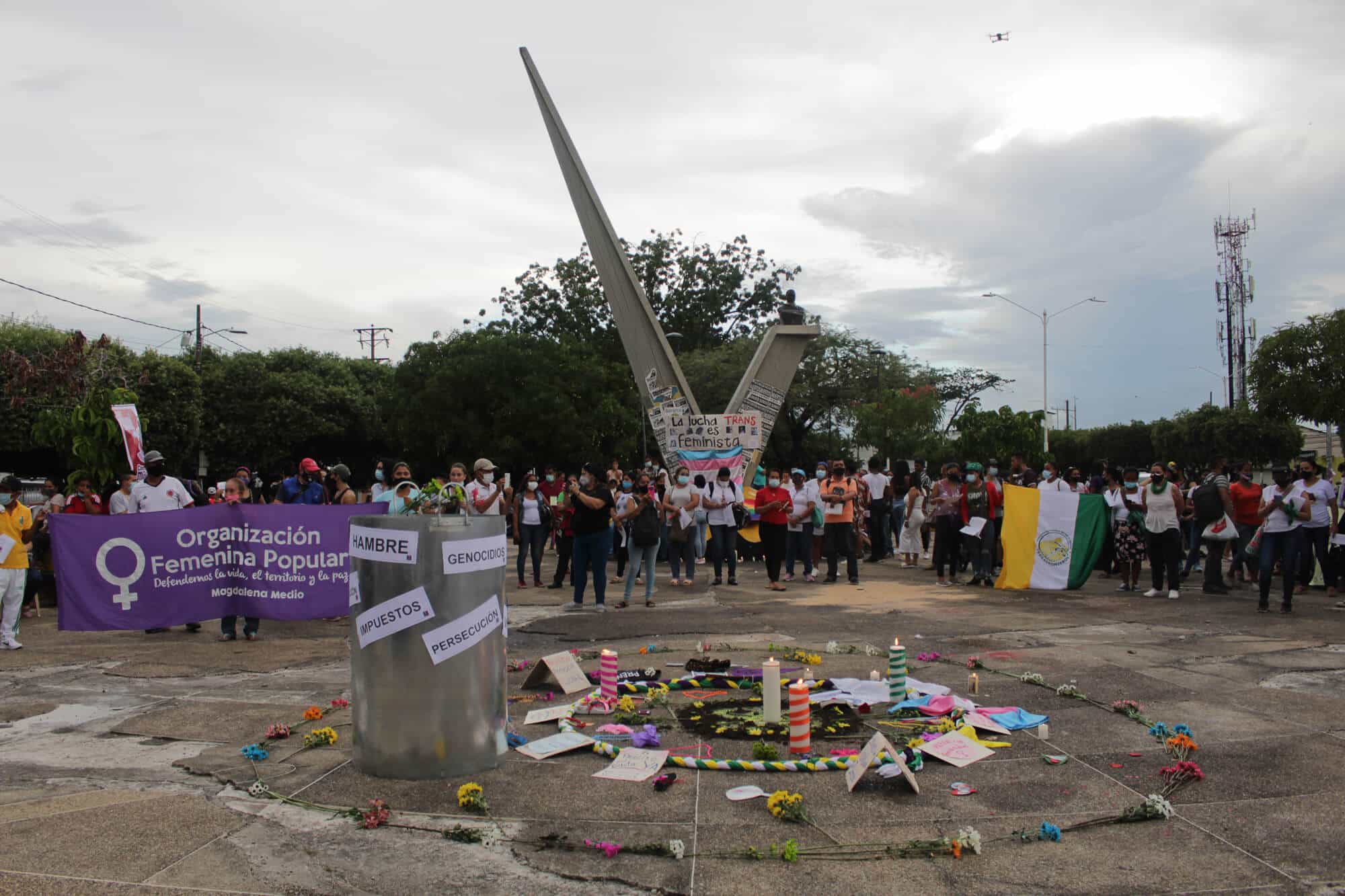
Public Action by the OFP

To learn more about delegations, click here.

COLOMBIA: Where is your sting?

 "You have to show them that you won't harm them," said Don Misael. He moved his hand toward the wasp nest and gently cradled it in his palm.  A half-dozen curious creatures explored his hand for several seconds as he slowly pulled it back before they flew back to the nest.

Saplings to commemorate the anniversary of the Las Pavas return

COLOMBIA: Where two or three... or fifteen are gathered

 Just weeks after the celebration of International Women's Day, on 22 March, the Popular Women's Organization (OFP) asked us to visit the house of a friend and OFP colleague, named Iluminada.  Her neighbor, a man who identifies himself as a paramilitary, attacked and threatened her in her home.   In a demonstration of solidarity, eleven women from the OFP showed up to her house that morning, plus four CPTers.

COLOMBIA: It is not too late to sign up for the 14-15 April 24-hour prayer-a-thon for peace in Colombia

 Join us for a virtual 24-hour prayer-a-thon for peace in Colombia.  In coordination with the Days of Prayer and Action for Colombia (DOPA), we want to gather prayers from all over the world over the course of a full day.  Click here to sign up for an hour, alone or with a group, between 6:00 p.m., Saturday, 14 and 6:00 pm Sunday 15 April 2012.  Light a candle, sing, meditate, read a story, or just sit quietly in the presence of God.

COLOMBIA REFLECTION: Consider the lilies. Then consider your investments.

Consider the lilies.  They’re not lilies.  I don't actually know what they are called.  But I did consider them.  Not even Solomon in all his glory was arrayed as one of these.  And there are two of them growing out of the wall on our patio, and several more out front. They thrive on nothing. No soil, no shade from the scorching sun, and they don't even seem to mind if it doesn't rain or if no one waters them for a week or more.  In fact they are they only plants we have that are still happy when my teammate Gladys returns after having been away for several days and rest of us have forgotten to look after the plants. 

COLOMBIA: Please join the twenty-four hour prayer-a-thon for peace peace in Colombia

Join us for a virtual 24 hour prayer-a-thon for peace in Colombia. In coordination with the Days of Prayer and Action for Colombia (DOPA), we want to gather prayers from all over the world over the course of a full day. Click here to sign up for an hour, alone or with a group, between 6:00 pm Saturday 14 April 6:00 Sunday 15 April 2012.  Light a candle, sing, meditate, read a story, or just sit quietly in the presence of God.

COLOMBIA: A Colombian youth tells you why you should go on a CPT delegation to Colombia 24 May-6 June 2012

Why go on a Christian Peacemaker Teams Delegation to Colombia?

A young Colombian conscientious objector who worked closely with a CPT Colombia delegation shared the following with participants in CPT’s October delegation:

To Our Friends in CPT,

We are the young people of the earth who go through the world with hands united.  We do not want another war to poison the night and darken the days.  We want to recognize the work of men and women in other parts of the world that with your support contribute to the building of a better world.  To our CPT friends who visited us in the first week of October we want to say thank you for getting to know our work and for spreading it to the world, thank you for strengthening our faith and hope and showing us that we are not the only ones who are struggling.  Thank you for the bonds of friendship that we have created and that foster learning and create ideas for change.  As Sister Teresa of Calcutta said: At times we believe that we are doing is only a drop of water in the ocean but the ocean would be less without it.  To everyone a thousand thanks!  May God bless us and strengthen us to continue building the kingdom of justice and peace that God has promised us.  
...
Fondly, A Youth of Barrancabermeja